
By Mark C Anderson, November 9, 2026
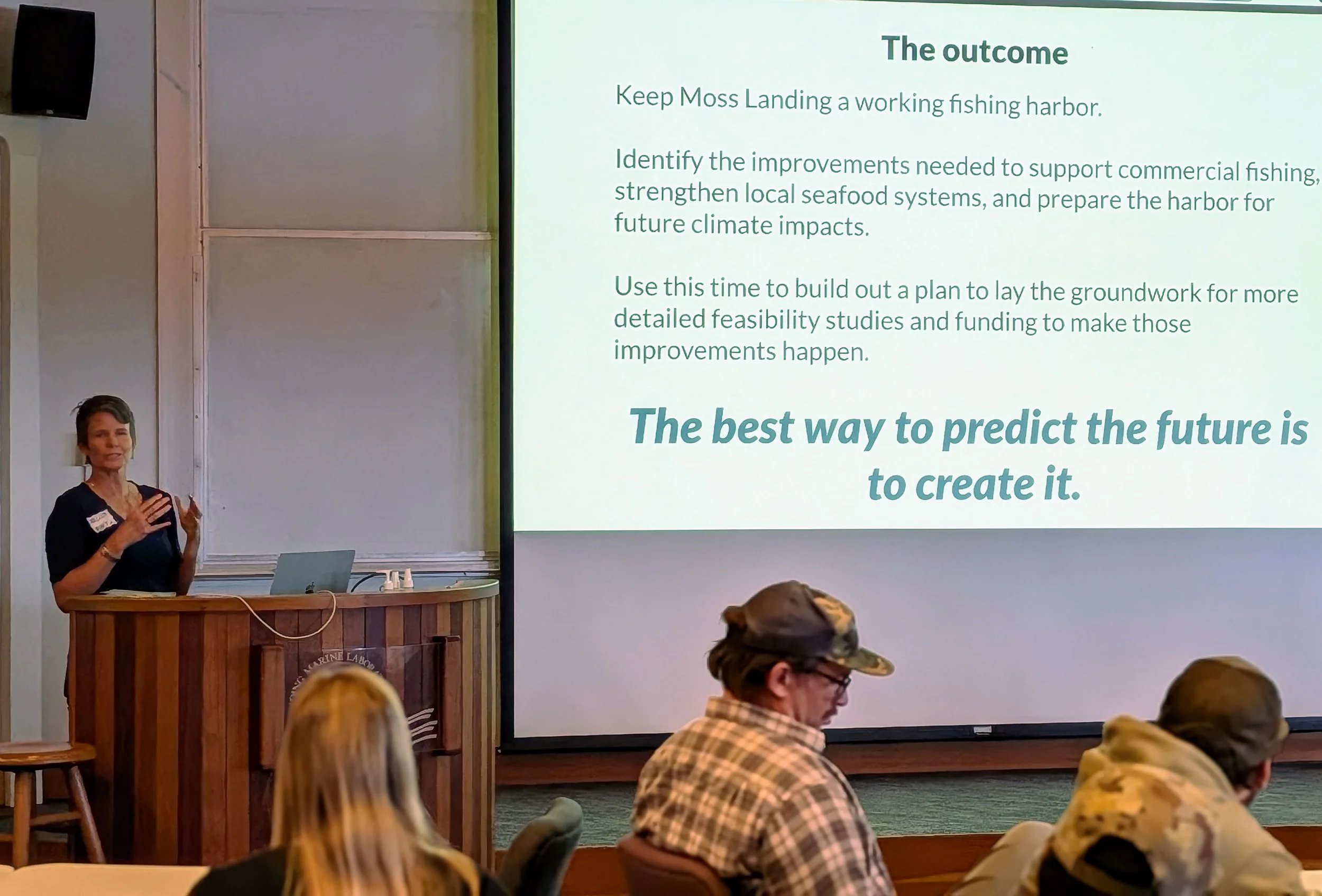
Melissa Mahoney Leading the October 26th Workshop in Moss Landing
Something magical happened on October 26th, as Monterey Bay Fisheries Trust (MBFT) gathered a group of Moss Landing Harbor stakeholders—mostly local fishermen, but also scientists, fishmongers, harbor officials, researchers, and political representatives—to discuss how to revitalize their fishing port without sacrificing its unique character.
That magic was most evident when two different MBFT staffers approached an unusual ceremonial bell that sits in the seminar room at Moss Landing Marine Laboratories (MLML) where the meeting took place.
It’s a special instrument, forged from heavy metal with gothic dolphins supporting its structure, and one that makes a big noise.
But when both swung the bell’s hammer against its rim, to announce—BONG!!!—it was time for one of the day’s many group talks to conclude, nobody heard it.
That’s how engaged and passionate the collaborative conversation was.
The central purpose of the meeting: to take long-term commercial fisheries data assembled in an unprecedented report, “Monterey Bay Commercial Fisheries: Status and Trends,” get real-time input, and plan meaningful action.
The study itself took nine months to complete, and tracked seven key local fisheries through 44 years of harvesting from Santa Cruz, Moss Landing, and Monterey harbors.
Its lead authors—Tim Frawley and Carrie Pomeroy of the University of California Santa Cruz, Rachel Zuercher of Monterey Bay Aquarium, MBFT Executive Director Melissa Mahoney, and their support teams—were all present at the meeting, and eager to share its information.
“This has been a long time coming,” Mahoney said. “We’re most interested in how we can help the harbor if we look at it from a systems level.”
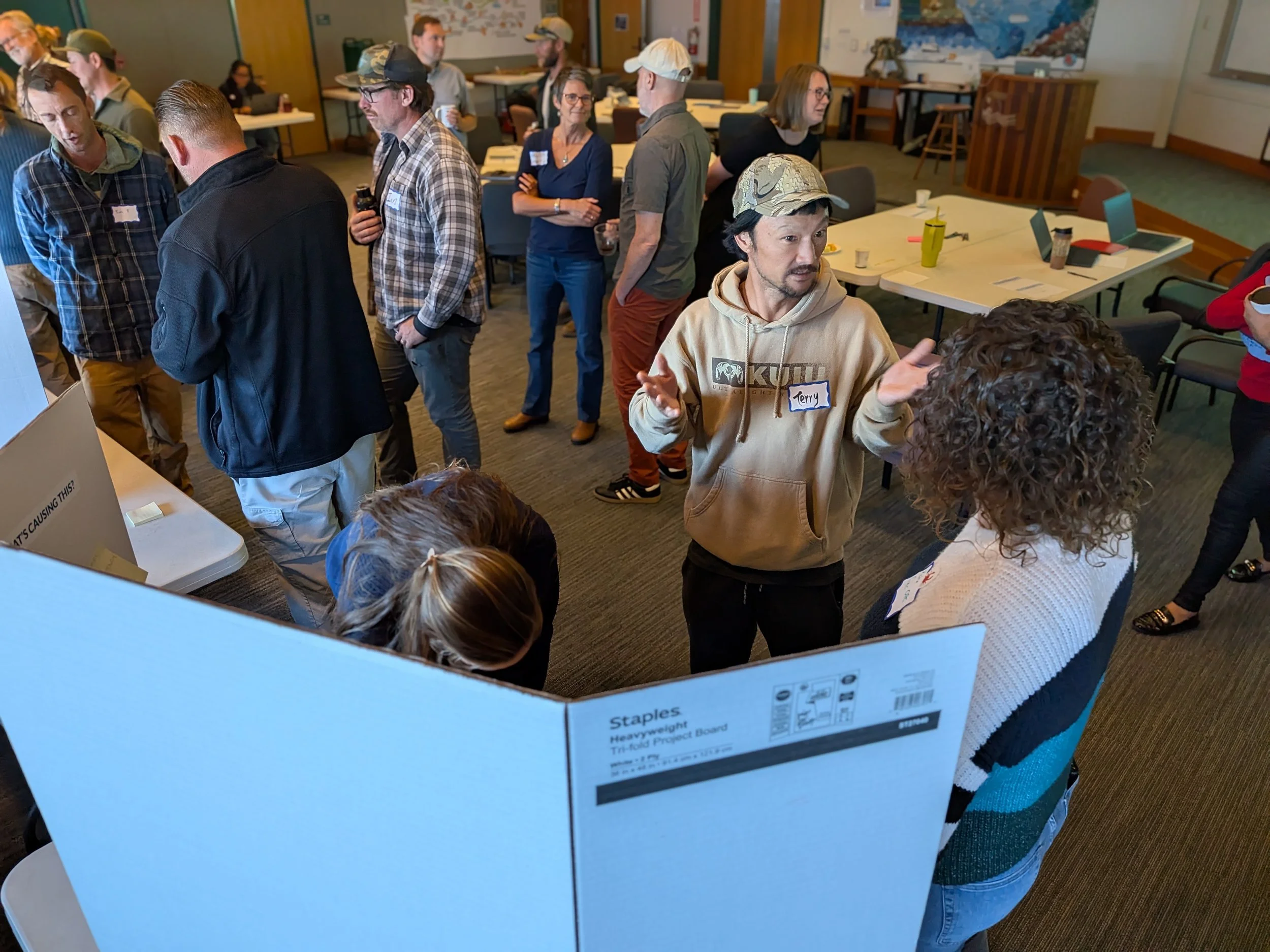
She noted that the session fits into a larger Future of Blue initiative launched with a foundational starting point, commercial fishermen, and a central question: “What does a thriving Moss Landing community look like?”
The revelations from the report—designed “to serve as a foundation and shared baseline of information to inspire community dialogue…[and] to identify needs and develop strategies that will build and enhance the resilience of Monterey Bay’s working waterfronts and seafood economy”—prove sobering yet empowering.
Among its findings: Fewer fishing boats are on the water, but the industry’s economic trajectory is up and down, rather than on a steady decline.
Waterfront infrastructure is deteriorated or absent; recent salmon and crab fishery closures cut off vital revenue; squid remains a major earner; and California halibut has become an important alternative catch.
In addition, cheap imports and climate change aren’t making things any easier, and recovering fish populations, while encouraging, do not translate to lucrative fishing livelihoods.
But there was galvanizing good news: There is vivid, and recent, proof of progress when fishing towns work as a team.
MLML professor and aquaculture research expert Luke Gardener put it poetically when he said, “When we sing from the same sheet…you’d be surprised how much more people listen.”
Fort Bragg presents a great example. Back in 2019, the Noyo Harbor District partnered with the city and other businessesto develop a Community Sustainability Plan. With a plan in place, they were able to secure millions of dollars in state grants to support improvements, such as a new icehouse which opened last summer.
Bodega Bay’s Spud Point Marina realized a similar build-out of their failing ice house via state, federal and California Air Resources funding.
Santa Barbara’s Ocean Collective has hatched a joint effort to foster education, marine entrepreneurship and workforce development with a $500,000 State Coastal Conservancy Grant. And there are more examples if you look.
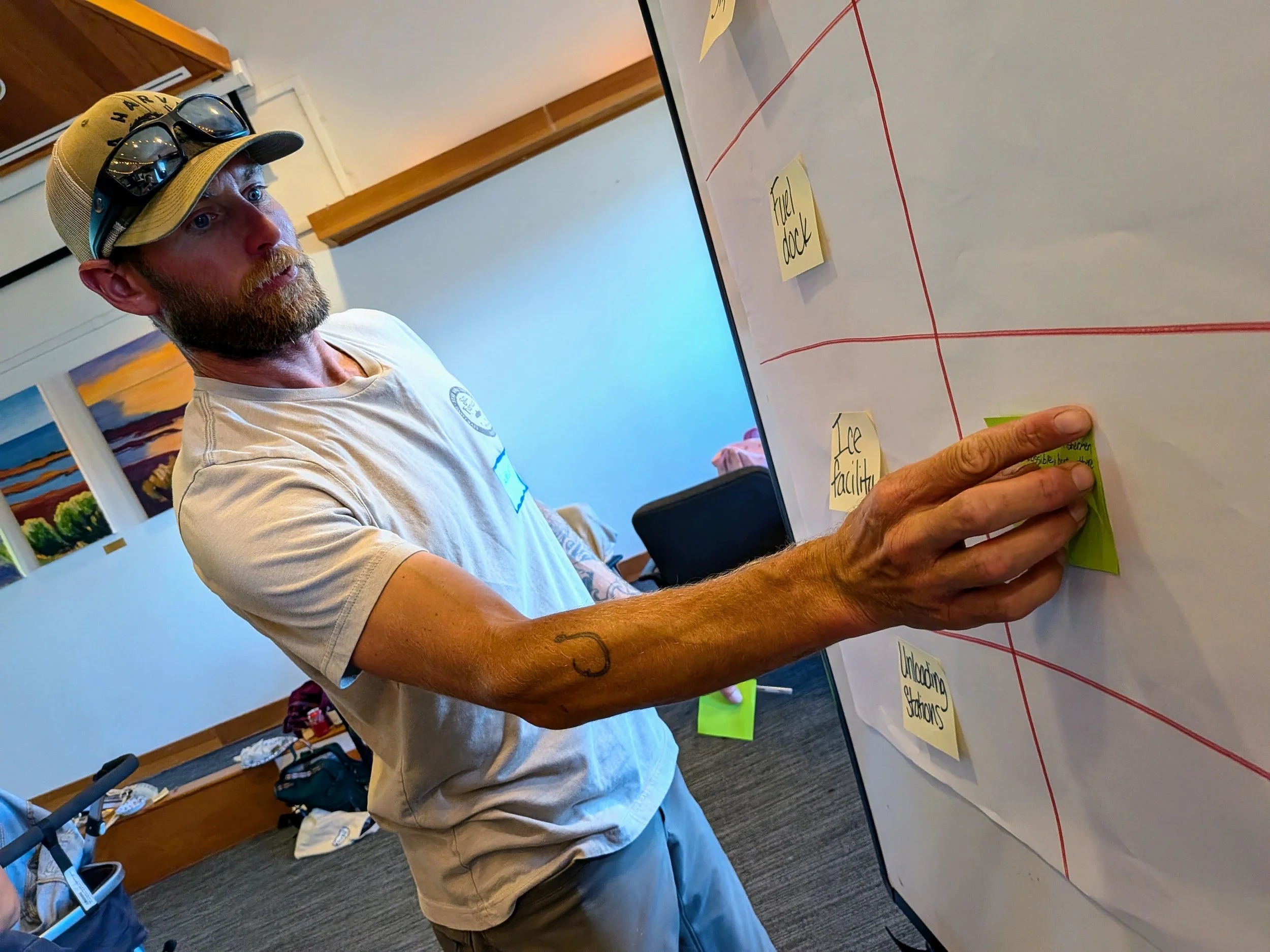
“We can be stronger as a community asking for what we want together,” Mahoney said, “and keep Moss Landing a working fishing harbor.”
Laying out goals and action items came next.
Ian Cole of Ocean2Table, a local community supported fishery (CSF) and seafood buyer, observed there’s no better regional location to realize those types of improvements than Moss Landing.
“There’s just more opportunity for change here than Monterey or Santa Cruz, no question about it!” he said. “If there’s going to be attention to infrastructure, this would be the place to do it.”
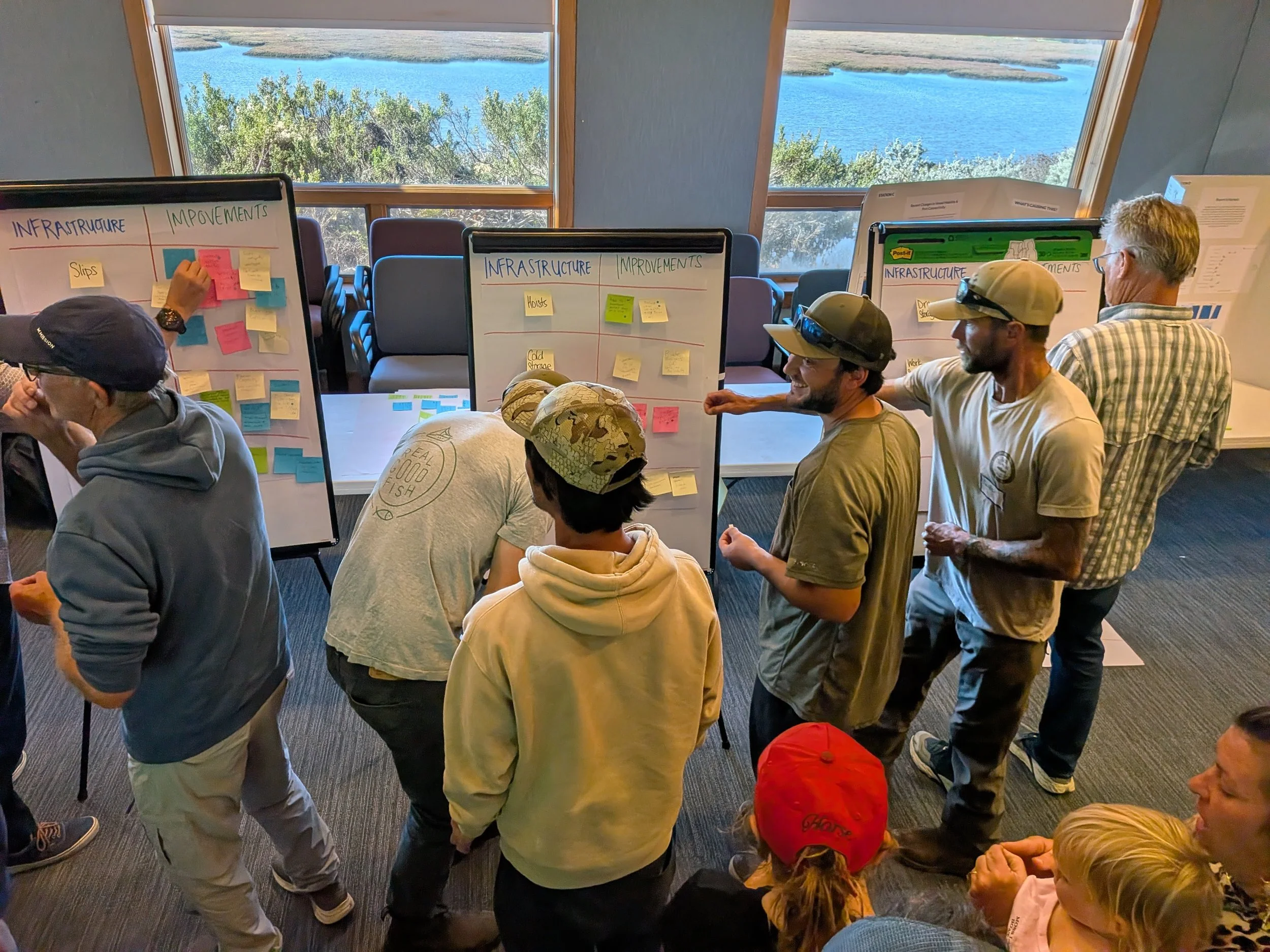
The meeting discussions resulted in a list of tangible priorities. The most pressing needs: access to clean seawater and space for holding tanks to preserve local catch; a shared icehouse; and a functional hoist (for loading product, gear, and ice on/off boats).
Frawley, an experienced commercial fisherman himself, helped put those ideas in a wider context.
“We’re tackling a lot of complicated and difficult problems, and we made a good start, but it’s hard to tackle them in eight hours,” he said. “We can leave with action items, but it’s important to ask, ‘How do we schedule more [collaboration] to accomplish more?”
That set the stage for a community event that followed on October 29th at The Haute Enchilada Café & Gallery.
The afternoon press conference doubled as a formal debut of MBFT’s effort to move “From Trends to Action” into real-world advances.
Put differently, it reiterates the idea that sharing is only meaningful if it generates actionable plans to ensure the next generation of fishing families has a working waterfront to come home to.
The Moss Landing Chamber of Commerce, the Monterey Peninsula Chamber of Commerce and the Pajaro Valley Chamber of Commerce & Agriculture co-hosted the session as elected officials and staffers, seafood and ocean research professionals, and partners and friends of the Trust packed the café.
"Data can tell us a lot about where we've been and how our fisheries have changed," Mahoney told the audience. "But data on its own doesn't keep a working waterfront working. People do. ‘From Trends to Action’ takes what we've learned back to the people who live it.”
She reminded listeners how a booming Moss Landing fishing industry reaches well beyond a sustainable harvest.
"Our working waterfront is more than a place where boats come and go," she said. "It is an economic engine, a source of local food, a keeper of knowledge and tradition, and part of who we are as a region.”
“There are days when we wonder whether supporting our local seafood economy registers alongside all the other important issues in our community. Seeing three chambers, our elected leaders, and the families who have fished this harbor for generations together in one room told us that it does."
Intrinsic to Mahoney’s comments was a thought emphasized in the Moss Landing stakeholder meeting’s outline, and something that resonates over the sound of even the loudest bell: “The best way to predict the future is to create it.”
Some challenging, but clear, opportunities to do that: continue holding fishing rights locally, supporting the next generation of fishermen through succession planning and leadership programs, and planning for the long term through the Future of Blue.
As The Trust notes with its appeal for community support, MBFT takes the long view because the waterfront can't afford a short one.
To learn more about MBFT’s Initiative, check out our website for more details.