
A top expert anticipates Godzilla El Niño impacts
By Mark C Anderson, October 5, 2026
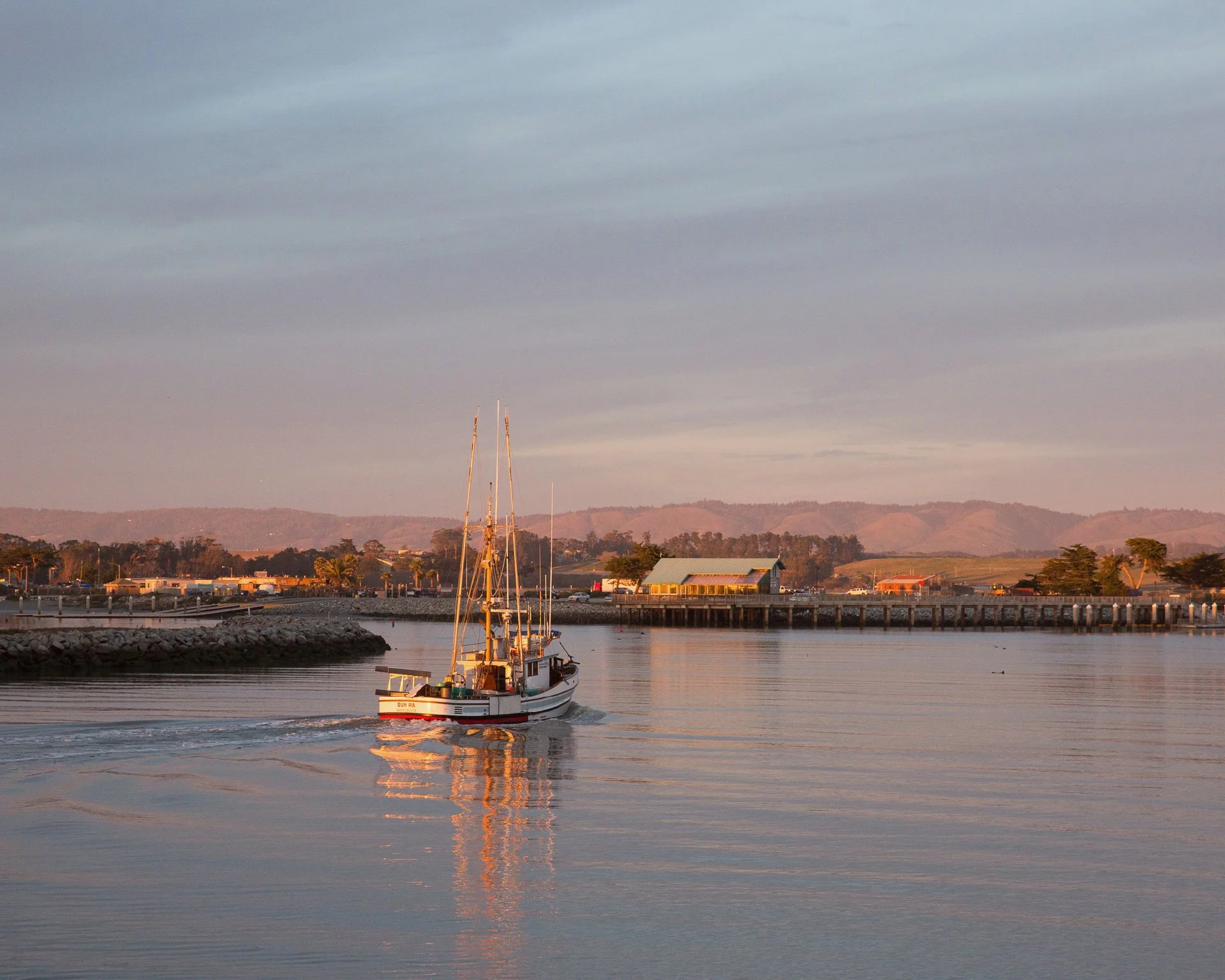
Fishing vessel pulling into Moss Landing
Disasters don’t usually allow for much anticipation.
That’s one of many truths unspooled by Anthony Rogers as he contemplates what’s coming this winter (and already building) with the so-called “Super El Niño”—aka “Whopper El Niño” or “Godzilla El Niño”—as it readies to torment the West Coast and well beyond.
“Normally you don’t get a heads up about a disaster,” he says. “We know this is coming.”
There are other crucial revelations he shares, including how helpful Godzilla El Niño warnings—which allow fishers, coastal communities, governments and more to prepare—are endangered by budget cuts.
Quick reminder: Rogers is not only one of the leading voices on fishery health in his role as a senior fellow of Fisheries Economics & Climate at the Ocean Conservancy, he’s also a Monterey Bay Fisheries Trust board member.
His recent “How Can Fishing Communities Respond to the Most Extreme Climate Shocks?” talk as part of the 2026 Bodega Marine Laboratory Seminar Series traversed an expanse of research.
He discussed how fishermen can manage big plot twists like Dungeness crab season closure, soaring sea surface temperatures, and fisheries shifting or shutting down. While acknowledging that diversification helps, he noted that major events create limitations to what the fleet can do to survive.
Rogers also contributed to a recent Ocean Conservancy report titled “West Coast Fishing Communities at Risk as Developing Super El Niño Threatens Key Fish Stocks, Livelihoods.”
It’s an illuminating read for all concerned citizens, coastal communities, environmental advocates and seafood lovers, not to mention the fishermen whose lives and livelihoods are at the mercy of the open sea.
“El Niño’s fuse has been lit, and we don’t have much time to prepare,” he says as part of the piece. “The 2016 El Niño was bad, but this is shaping up to be worse: temperatures are up, the seafood economy is down, and disaster relief still has the same problems it did then.”
Here are other key insights he shared with MBFT, with some context added where appropriate.
Warnings exist to protect from danger.
Anthony Rogers, Senior Fellow of Fisheries Economics & Climate at the Ocean Conservancy
“Normally you don’t get a heads up about a disaster,” Rogers says. “It’s a dramatic shock to the system. We know this is coming. Which means Congress should do something.”
To that end, Ocean Conservancy experts like Rogers are recommending Congress appropriate funding for fishery disasters associated with this Super El Niño before they happen.
“There is growing concern in Washington, D.C., with headline after headline, about what this is going to mean,” he says. “No pun intended: It’s really heating up as an issue. It’s Congress, so how quickly [funding] goes through is out of my hands, but it doesn’t mean we can’t advocate for that.”
Compromising warning systems isn’t wise.
“It’s important to remember the only reason we have a heads up that the Super El Niño is coming is NOAA and all the ocean monitoring it does, which is supported by federal budget appropriations,” Rogers says. “Seeing that budget item on the chopping block for yet another year in a row is troubling.
“If many in Congress hadn’t defended NOAA’s budget, we simply wouldn’t have this heads up, or the chance to anticipate what impacts are on wildlife and fisheries.”
There are real avenues to confront something as terrifying as Godzilla.
A climate incident of this scale and intensity feels scary, even overwhelming.
Rogers and his colleagues at the Ocean Conservancy had that in mind when they recently identified nearly 30 management actions for the next two years to improve the resilience of fish populations.
“Part of the motivation for that paper is because of this hesitancy I hear a lot: ‘Climate change is such a big issue,’ or ‘Things take so long to change, it’s so tough.’”
Rogers goes on to say, “We wanted to kick the tires on that assumption. Turns out there’s a lot we can do in the short term that would represent progress. Resiliency involves a lot of work. But it’s not this monstrous thing. There’s a lot of straightforward things to be done.”
Anticipation involves what’s very hard to anticipate.
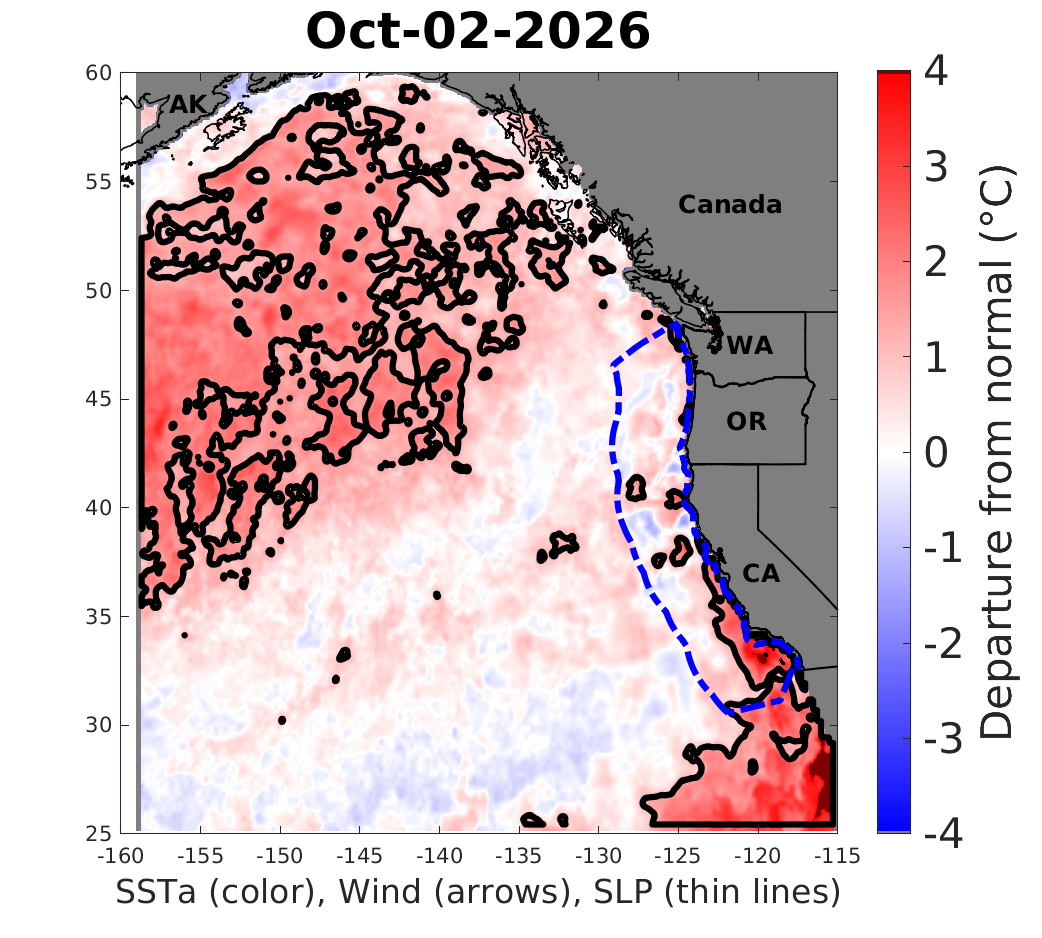
Image from NOAA’s Warm Blob Heat tracker
Rogers pauses to point out that the last time the El Niño weather pattern came following a marine heat wave known as “The Blob.”
“Things were really weird—and complex—as we tried to figure out ‘How much was the Blob and how much El Niño?’” he says. “Fishermen are pretty good at rolling with changing conditions, and as far as we can tell, it’s going to have a significant impact, affecting things in both similar ways but very differently than previous El Niño patterns. With fishermen, there’s a growing concern, and they’re seeing some weird stuff already out on the water.”
The main takeaway, in other words, is that we have predictive models, but the unexpected can be expected: “As the National Oceanic and Atmospheric Administration (NOAA) points out: The past is not prologue. We can’t say, ‘This [outcome] definitely is going to happen.”
Reminder: Even something as complex as the planet’s oceans are connected.
“Everything is tied together,” Rogers says. “When prey at the base of the marine food web moves or is less productive, all sorts of things happen: increased risk of entanglements, starving sea lions and seabirds.”
He continues from there. “People who know nothing about fishermen still care about oceans, and those developments affect how and when fishermen can go fishing,” Roger says. “This is not a scenario where one fishery or one individual will be affected. El Niño affects everyone.”
Relief should be reliable.
Another Rogers thought shared with the L.A. Times rings loudly, and relates to how the federal process for supporting financially affected fishermen “may lead to further pain” because the support response often takes years to process.
Rogers observes the federal disaster relief program is “almost universally believed to be broken,” adding, “Imagine you got a hurricane or tornado, and it destroyed your house, and then you’re told, ‘We’ll pay you for that in three years.’ Most people can’t do that, and fishermen are no different.”
There’s a key ingredient often absent in the current dialogue.
When asked what’s missing from the current Super El Niño dialogue, Rogers has an answer at the ready.
“We have the proposed cuts to NOAA’s budgets, and we know the uptick in delays regarding regulations and season openings,” he says. “Every agency is short staffed. There’s stuff they want to do or are tasked to do and don’t have the people to do it.”
Which leads to a ruthless—and preventable—cycle.
“All of this creates higher levels of uncertainty,” Rogers says. “We don’t have managers and scientists able to keep an eye on the ocean and fisheries the way they did before.
“We’ve never dealt with this big of an environmental situation l, and everything is teetering because of cuts that have already happened. That’s what is missing.”
Which gets back to the opportunity on the eve of the oncoming storm: There are ways to heed the warnings, if stakeholders and leadership are willing to listen—and willing to act.